
Hand metal spinning
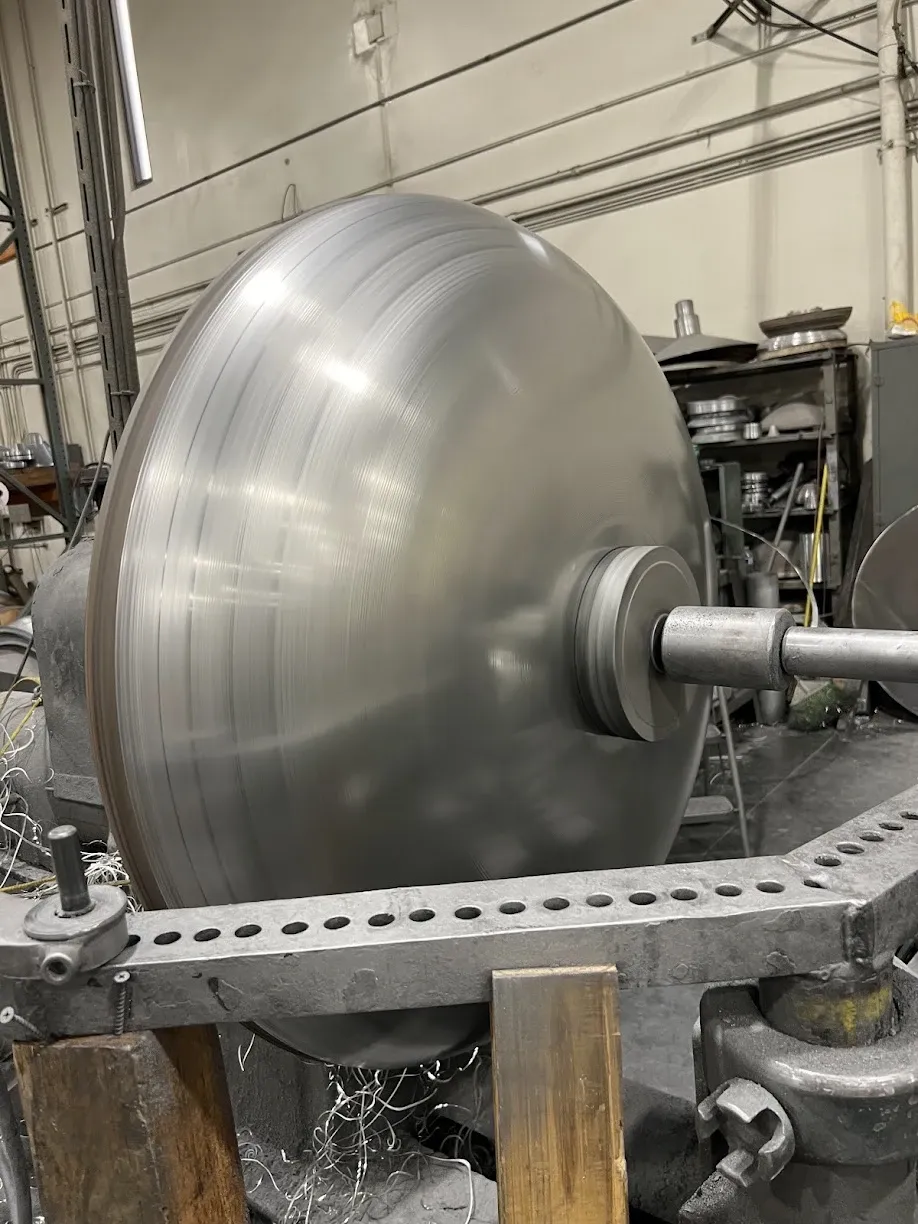
A flat metal disc is spun on a lathe and pressed by hand over a shaped tool until it takes the tool's form. It's ideal for round parts like domes, cones and shades, and the tooling costs far less than stamping or deep drawing.
Spinning capabilities
Every part is spun by hand by an experienced spinner, not on a CNC machine. That makes short runs, prototypes and design changes fast and affordable.
We build the tooling in-house and keep it on file, so a repeat order goes straight to production.
Request a spinning quote| Method | Hand spinning |
|---|---|
| Maximum diameter | 60 in. |
| Materials | Aluminum, copper, brass, steel, stainless steel |
| Production quantity | 1 to 4,000 parts |
| Typical lead time | 7 days, tooling and production |
| Tooling | Built and owned by SRJ, stored for repeat orders |
| Quote turnaround | Within 1 business day |
Shapes we spin
Spinning produces round, symmetrical parts. Parts can also be cut into sections afterward for other shapes.
- Domes and hemispheres
- Cones
- Cylinders
- Lamp shades and reflectors
- Canopies
- Bowls
- Flanged covers
- Stepped covers
- Parabolic shapes
- Venturi shapes
- Flanged and dished heads
Materials and thickness
We spin aluminum, copper, brass, steel and stainless steel.
How thick a sheet we can spin depends on the metal and the part's size. Aluminum can be spun in the thinnest gauges, and steel in the heaviest. Send us your drawing and we'll confirm the gauge range for your part when we quote.
Tolerances
Spun-part tolerance depends on diameter, metal and thickness. The ranges below are typical commercial tolerances for spun parts from the Precision Metalforming Association's industry guide. We'll confirm the tolerance we can hold on your part when we quote.
| Finished diameter | Typical tolerance |
|---|---|
| Up to 24 in. | ±0.015 to 0.031 in. |
| 25 to 36 in. | ±0.031 to 0.047 in. |
| 37 to 48 in. | ±0.047 to 0.062 in. |
| 49 to 60 in. | ±0.062 to 0.094 in. |
Designing a part for spinning
A few details on your drawing help us quote accurately and spin the part right the first time.
Give an inside diameter
Spinning forms the metal over the outside of the tool, so the inside diameter is what we control most precisely. If you only give an outside diameter, expect it to vary with the metal's thickness.
Expect thinner walls
The bottom of a spun part stays at the original sheet thickness, but the sidewalls stretch and can thin by up to about 25%. If a wall thickness is critical, mark it on the drawing.
Avoid sharp corners
Plan for inside corner radii of at least two to three times the metal thickness. Tighter corners are sometimes possible on thicker metal.
Mark the critical dimensions
Call out the dimensions that matter instead of one tolerance for the whole part. Looser tolerances where they don't matter keep tooling and part costs down.
Surface finish
Hand-spun parts show fine concentric lines from forming. If you need a smoother look, ask about polishing or powder coating.
Bring a drawing or sample
We work from your dimensioned drawing or an existing part. We don't create CAD drawings from sketches.
How an order works
Send your part
Upload a drawing or photos, or bring a sample part, along with the metal and quantity.
Get a quote
We price tooling and parts within one business day.
We build the tooling
We make the spinning tool in-house and keep it on file for reorders.
Spin and deliver
Parts are typically ready in about 7 days, for pickup or regional delivery.
Ready to price your spun part?
Send a drawing or a sample part. You'll have a quote within one business day.